

What registration pathway am I eligible for? A guide for IMGs
Are you an international medical graduate (IMG) thinking of working as a doctor in Australia? This guide explores the different registration pathways to help you understand your options for practicing medicine in Australia.

While the registration process can feel daunting, identifying your pathway to registration is the first step toward practicing in Australia. This guide will provide you with all the essential information you need to help you understand the requirements of each pathway and choose the right route for your career.
Australia offers five registration pathways for IMGs. Your eligibility depends on where you obtained your qualifications, your level of training, your previous clinical experience, and your career goals.
Each pathway involves assessment and each has different eligibility requirements. All IMGs must complete a pathway to be eligible for registration with the Medical Board of Australia. For all pathways IMGs must have a primary qualification in medicine and surgery awarded by a training institution recognised by both the AMC and the World Directory of Medical Schools (WDOMS).
Registration Pathways
- Competent Authority Pathway
The Competent Authority pathway is for IMGs seeking general registration in Australia. To be eligible for this pathway you must have been assessed by a competent authority, and have practised in a competent authority country in a supervised position. The recognised competent authorities are:
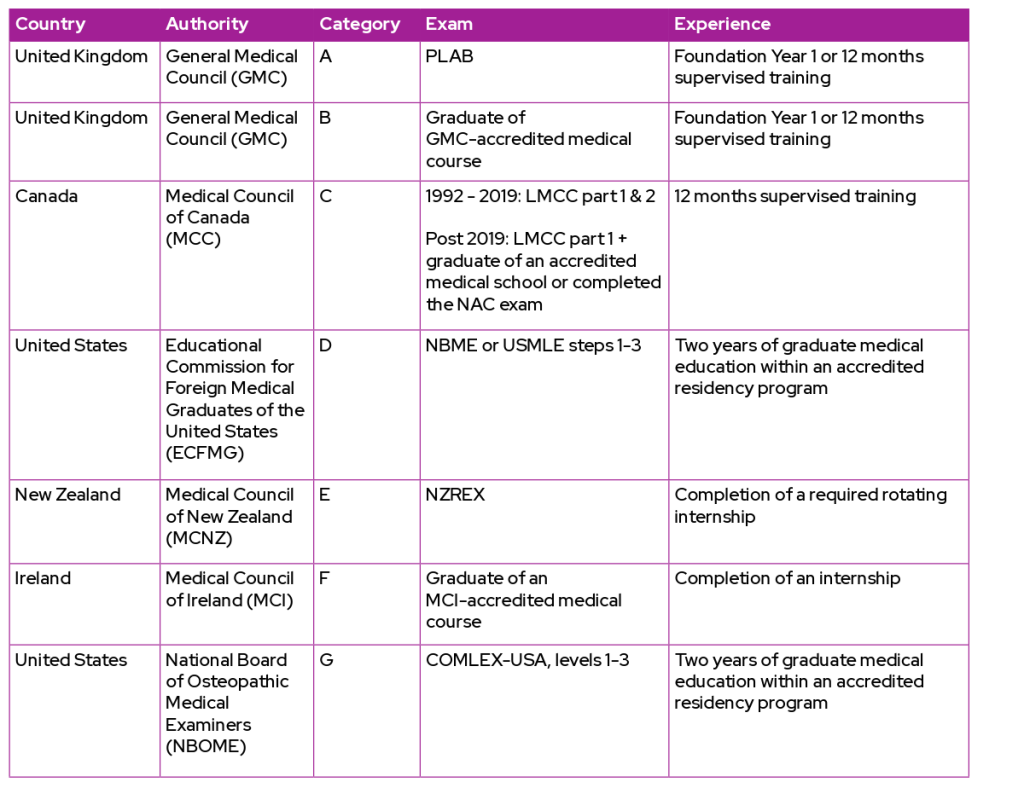
Both the examination AND the experience are required to qualify for the competent authority pathway. The Medical Board will accept an application from an IMG who has completed a medical program or assessment from one category and the experience component from another category as long as the component is completed exactly as defined in that category and approved by the competent authority of the country in which it was completed.
IMGs on this pathway do not need to sit the Australian Medical Council (AMC) exams. Once granted provisional registration, you need to complete 47 weeks of supervised practice before progressing to general registration.
- Standard Pathway
The Standard pathway is for IMGs seeking general registration who are not eligible for alternate pathways. To be eligible for the Standard pathway, you must pass the AMC CAT MCQ written exam before you apply for limited registration.
Once you have passed the AMC CAT MCQ written exam, you can complete either the AMC clinical examination or the workplace-based assessment (WBA) to get your AMC Certificate. When you have satisfactorily completed 12 months of supervised practice (minimum of 47 weeks of full-time equivalent (FTE) practice) and either the clinical exam or WBA, you can apply for general registration.
GP’s: If you are an international medical graduate (IMG) on the Competent Authority or Standard pathway and you will be working in general practice, and are not concurrently applying for a general practice assessment on the PEP Specialist pathway, you will need to complete a pre-employment structured clinical interview (PESCI).
- Specialist Pathway
The Specialist Pathway is for overseas-trained specialists who wish to be recognised and work as a Specialist in Australia. To be eligible for the Specialist pathway, you must have satisfied all the training and examination requirements to practise in your field of specialty in your country of training. The Specialist pathway leads to specialist registration and is for all recognised medical specialties.
Specialist international medical graduates (SIMGs) apply to the relevant specialist medical college for a comparability assessment. SIMGs who want to work in an area of need can apply for an area of need assessment by the specialist medical college at the same time.
The specialist college will send you the outcome of the assessment – either substantially comparable, partially comparable or not comparable. If you are assessed as substantially or partially comparable, you will need to secure a suitable position. If you are assessed as not comparable, you will not be eligible for specialist registration but you have the option to apply for a different pathway.
If you are also eligible for the Competent Authority pathway you will initially apply for provisional registration. If you are not eligible for the Competent Authority pathway, you will be applying for limited registration. On completion of your requirements for Fellowship of the specialist college you will progress to apply for specialist registration.
- Expedited Specialist pathway
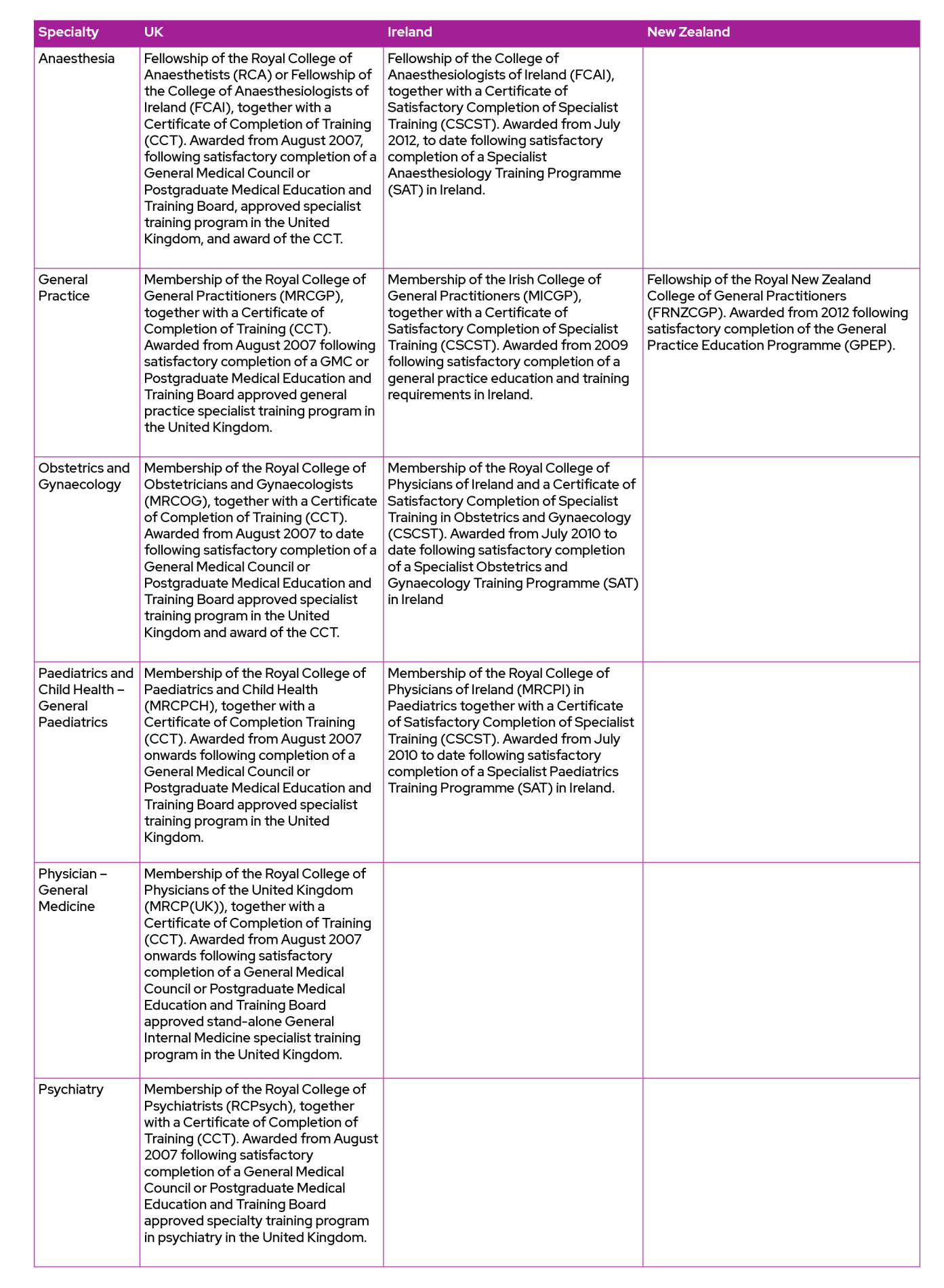
The Expedited Specialist pathway is for eligible internationally qualified specialists who seek specialist registration in Australia. This pathway leads to specialist registration.
To be eligible for the Expedited Specialist pathway, you must have a specialist qualification that is on the Medical Board’s Expedited Specialist pathway: accepted qualifications list.
The curriculums for specific specialist qualifications have been assessed in collaboration with the Medical Board of Australia, the Australian Medical Council and the specialist colleges. If you gained your specialist qualifications on curriculums prior to those assessed you will not be eligible for the expedited pathway and will need to apply via the Specialist pathway.
This pathway does not lead to Fellowship of the colleges and you will need to be assessed by the college separately in this regard.
If you are dual-qualified or you hold a combination of qualifications of which only some are listed on the accepted qualifications list, contact us for advice on your eligibility for the Expedited Specialist pathway.
The current specialties on the list are:
- Short-term Training in a Medical Specialty Pathway
The pathway is for IMGs who are overseas-trained specialists or specialists-in-training who are not eligible for the Competent Authority pathway and wishing to undertake a short period (usually up to 24 months) of specialist or advanced training in Australia. You will apply for temporary limited registration.
To be eligible for this pathway, you must have satisfied all the training and examination requirements to practise in your field of specialty in your country of training OR be within two years of completing your specialist training. You also need to have already secured an offer of a training position in Australia.
This pathway is designed for temporary training purposes and does not lead to general, specialist or ongoing registration in Australia. Once you have completed your training period, if you would like to remain in Australia, you will need to qualify for another registration pathway.
Getting Started: Applying for registration
Once you have identified your registration pathway, prior to applying for registration you will need to create an Australian Medical Council (AMC) portfolio and verify your qualifications with the Educational Commission for Foreign Medical Graduates (ECFMG), a division of Intealth. You will need to apply to the ECFMG to establish a MyIntealth account and an EPIC portfolio for verification of your qualifications.
For more information read our guide to getting your qualifications verified in Australia.
Please note: Fees apply when establishing your AMC Portfolio, MyIntealth Account and adding additional qualifications to be reviewed by the AMC.
How can Elective Recruitment help?
At Elective Recruitment, we specialise in connecting doctors with Australian career opportunities and streamlining the transition through expert regulatory and registration support. If you are looking for further guidance on AHPRA registration, this is something our team can help you with.
Ready to start your Australian journey? Contact us today at at hello@elective.com.au
About the Author
Hayley has over a decade of experience in medical recruitment, where she has developed a deep expertise and understanding of the unique challenges and complexities that doctors face when relocating to Australia. Assisting in permanent, fixed-term, and locum placements across all medical specialties, she guides doctors through the complex journey of regulatory and migration processes, ensuring each candidate has a smooth transition into their new role.
